📌 Key Points
- No single formula decides it: AC age, repair cost, warranty coverage, repair history, comfort, efficiency, refrigerant type, and the condition of the rest of the system all matter.
- Ten years is an evaluation point, not an expiration date: ENERGY STAR recommends considering replacement when an air conditioner or heat pump is more than 10 years old, especially when repairs are frequent or energy bills are rising.
- Small repairs can still make sense on an older AC: A capacitor, contactor, thermostat, condensate problem, or other limited repair does not automatically justify replacing an otherwise serviceable system.
- Major repairs deserve a full comparison: An expensive compressor, evaporator coil, refrigerant circuit, motor, or control repair on an older out-of-warranty system is a good time to price both repair and replacement.
- R-410A systems are still repairable in 2026: Federal rules allow existing R-410A systems to be maintained and repaired with compatible R-410A service components. There is no federal requirement to replace a working R-410A system.
- Replacement should solve more than the broken part: A good replacement decision should consider proper sizing, matched equipment, duct and airflow conditions, humidity control, efficiency, warranty coverage, and long-term ownership plans.
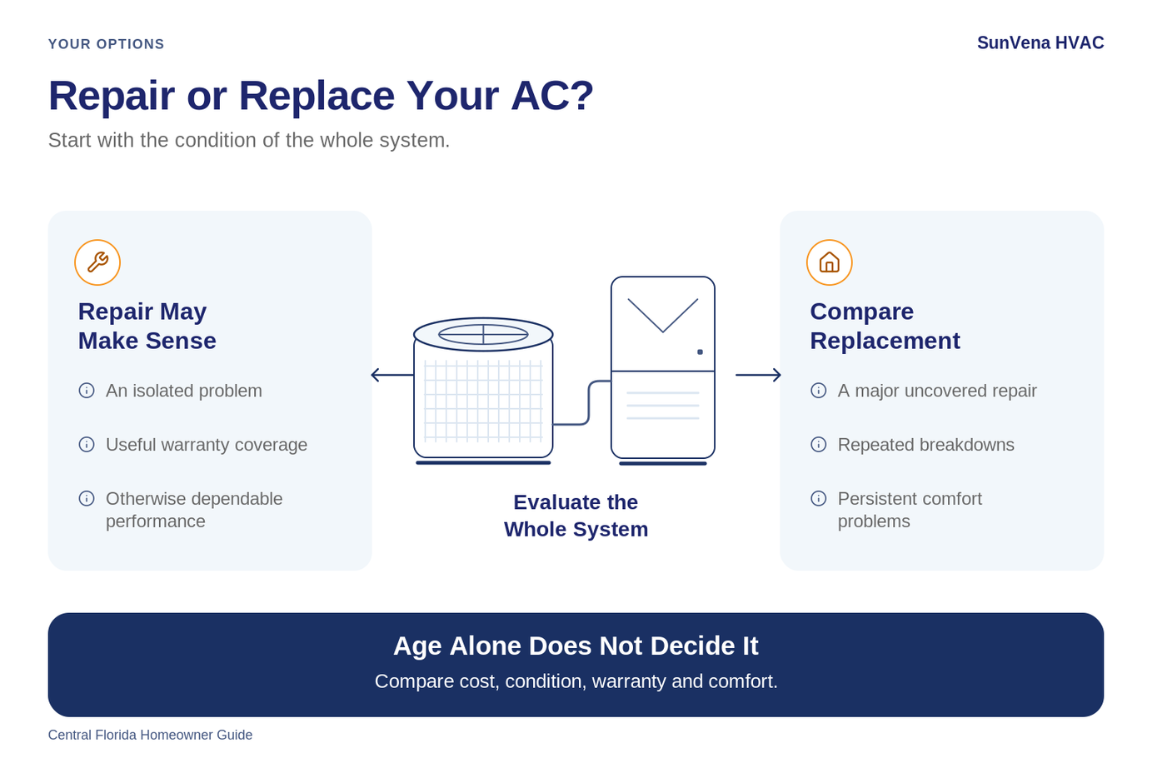
If your air conditioner breaks in Central Florida, repair usually makes the most sense when the system is relatively young, the problem is isolated, warranty coverage is still strong, and the rest of the equipment is in good condition. Replacement deserves a closer look when the system is older, major repairs are becoming expensive or frequent, comfort has declined, or you would be investing heavily in equipment that may have limited remaining service life.
The important part is not to let one shortcut make the decision for you. The popular “$5,000 rule” and “50 percent rule” can help frame the conversation, but neither is an official ENERGY STAR, EPA, ACCA, DOE, or manufacturer replacement standard. A good repair-or-replace decision compares the actual repair, the condition of the complete system, warranty coverage, likely future needs, and a real replacement quote.
Should You Repair or Replace Your AC?
Start with six questions:
- How old is the system? Age matters because the probability of additional wear-related repairs generally increases as equipment accumulates operating hours, but age alone does not mean an AC needs replacement.
- What exactly failed? A condensate problem or failed capacitor is a very different decision from a compressor failure, leaking evaporator coil, or multiple major component problems.
- How much will the repair actually cost? Compare the complete repair estimate, including labor, refrigerant, materials, and any diagnostic charges, against the installed cost of an appropriate replacement.
- What does the warranty cover? Parts, labor, refrigerant, and system-replacement coverage can be different. A major component that is still under warranty can change the economics substantially.
- Has the AC been reliable? One repair after years of dependable operation is different from repeated breakdowns over the last one or two cooling seasons.
- How well does the system perform when it is working? Persistent humidity, uneven temperatures, excessive noise, weak airflow, or high energy use may point to broader equipment, duct, airflow, or sizing issues that a single repair will not necessarily solve.
Is the $5,000 Rule a Good Way to Decide?
The “$5,000 rule” is a common HVAC rule of thumb: multiply the age of the equipment by the repair estimate. If the result is above $5,000, replacement is often presented as the better choice. For example, a 12-year-old system with a $700 repair produces a score of 8,400, above the 5,000 threshold.
It is useful as a quick screening tool, but it should not be treated as a decision rule. The fixed $5,000 threshold does not account for equipment capacity, installation complexity, regional replacement prices, inflation, warranty coverage, the type of failure, or the condition of the remaining components. A $450 repair on a 15-year-old unit scores 6,750, above the threshold, yet it can still be sensible if the system otherwise performs well. A much larger repair on a younger system may also make sense if a manufacturer warranty covers the expensive part.
The same limitation applies to the “50 percent rule,” which suggests comparing the repair cost with roughly half the cost of replacement. It is a useful comparison point, not a technical or regulatory standard.
Use these rules to trigger a comparison, not to make the decision for you.
How Much Should AC Age Matter in Central Florida?
Central Florida air conditioners often accumulate substantial annual runtime because cooling and dehumidification are needed through much of the year. That makes age relevant, but there is no accurate conversion such as “one Florida year equals a certain number of northern years.” Installation quality, maintenance, equipment design, coastal exposure, airflow, duct conditions, electrical conditions, and usage all affect service life.
ENERGY STAR recommends considering replacement when an air conditioner or heat pump is more than 10 years old. It also points to frequent repairs, rising energy bills, comfort problems, and humidity issues as reasons to have the system evaluated.
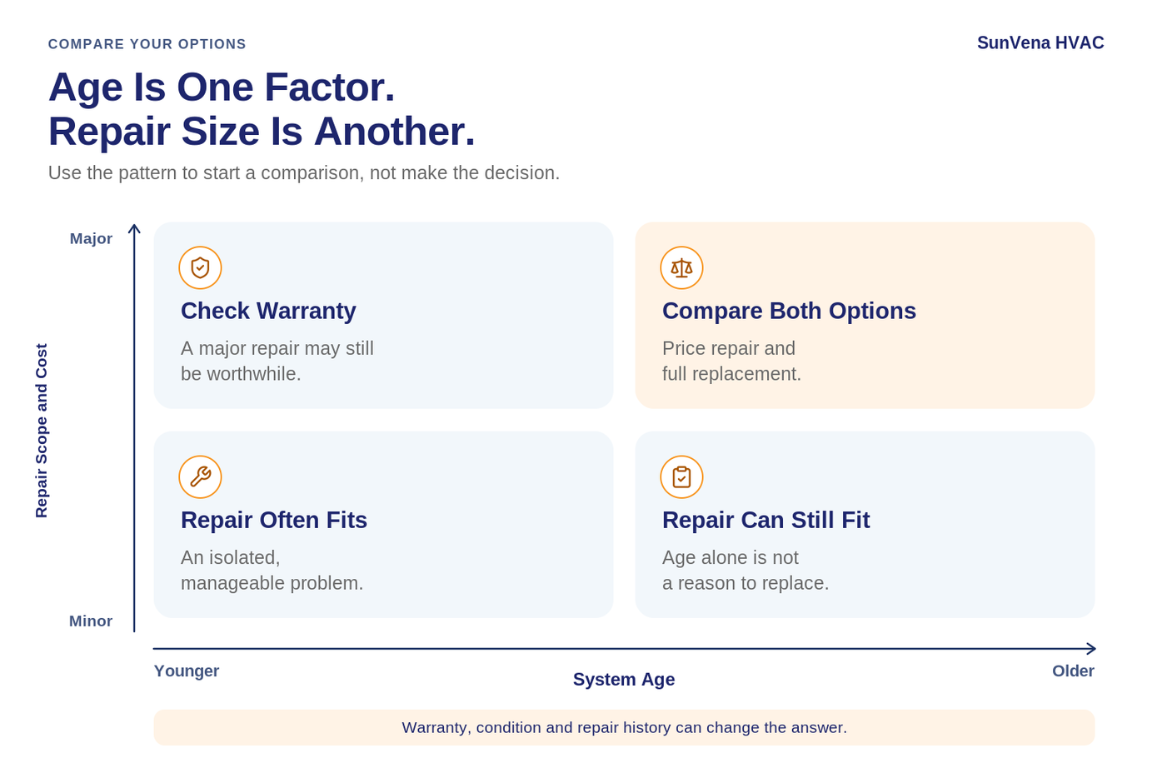
That does not mean a 10-year-old AC should automatically be replaced. A 10- or 12-year-old system with a minor repair, good maintenance history, acceptable energy use, and strong overall condition may still be worth repairing. Age matters more when it’s paired with a costly failure, repeated repairs, poor comfort, or an expired warranty.
Which AC Repairs Usually Favor Repair, and Which Deserve a Replacement Quote?
| Repair or Problem | How to Think About It | When Replacement Deserves More Attention |
|---|---|---|
| Capacitor, contactor, relay, thermostat | Often an isolated repair if the rest of the system is healthy | When it is one of several recent failures or the system already has major performance problems |
| Condensate drain, float switch, drain pan issue | Usually a drainage or safety-control repair rather than a reason by itself to replace the AC | When water damage, corrosion, inaccessible failed components, or other major equipment problems are also present |
| Condenser fan or blower motor | Often repairable, with warranty status and motor type affecting cost | When an older system has additional major issues or an expensive proprietary motor is part of a broader decline |
| Refrigerant leak | Depends on leak location, repairability, refrigerant type, repair history, and warranty coverage | When the leak is in an expensive coil, leaks have repeated, or the total repair cost is high relative to the value and condition of the system |
| Evaporator coil replacement | Can make sense on a younger system or when strong parts coverage applies | When the system is older, out of warranty, has other wear, or the repair requires substantial labor and refrigerant |
| Compressor failure | A younger system with compressor coverage may still be a good repair candidate | An older out-of-warranty system should usually be priced both ways before approving a major compressor repair |
| Control board or variable-speed electronics | Repairability depends heavily on part availability, warranty, diagnosis, and equipment design | When the repair is expensive and the system also has age, comfort, refrigerant, or reliability concerns |
The table is intentionally not a list of automatic “repair” or “replace” answers. The same failed component can lead to different decisions on two different systems.
How Does Warranty Coverage Change the Decision?
Check the model and serial numbers before approving a major repair. Many HVAC warranties cover specific parts but not the labor, refrigerant, diagnostic work, shipping, or other costs needed to complete the repair. Registration requirements and warranty lengths also vary by manufacturer, equipment family, installation date, and original ownership terms.
A compressor or coil that would be hard to justify paying out of pocket may still be worth repairing if the expensive component is covered. Ask for the repair estimate to separate covered parts from homeowner-paid labor, refrigerant, and other charges.
For replacement comparisons, look at the actual warranty being offered rather than assuming every new system has the same coverage. SunVena HVAC’s current installation materials advertise warranties of up to 12 years on parts and labor on qualifying installations, depending on the equipment and applicable warranty terms. Manufacturer parts coverage requires registration.
What Changed for R-410A Repair and Replacement in 2026?
R-410A matters in a repair-or-replace decision, but the federal rules are often described incorrectly.
Existing R-410A systems can still be repaired. The EPA specifically allows homeowners to maintain and repair existing R-410A systems. Compatible R-410A condensing units, evaporator coils, compressors, and other components can continue to be manufactured and sold for servicing existing equipment, subject to the applicable labeling and program requirements.
You are not federally required to replace a working R-410A system. No federal expiration date forces a homeowner to remove an existing R-410A air conditioner simply because of its refrigerant.
EPA rules also do not categorically prohibit replacing one major R-410A component. EPA’s homeowner guidance specifically says a failed R-410A condensing unit, indoor coil, or other component can be replaced with a similar R-410A component as a repair to an existing system. Whether that is the best technical and financial choice depends on equipment compatibility, manufacturer requirements, matched-system performance, efficiency, part availability, and warranty implications.
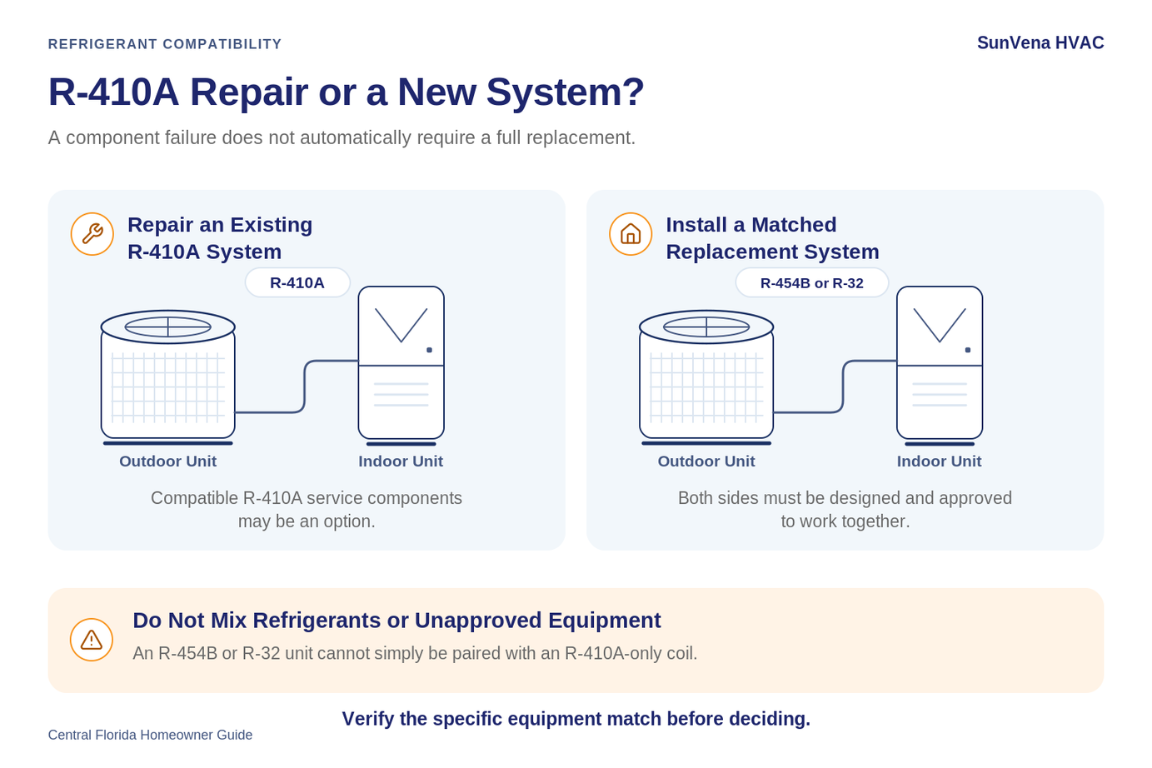
New lower-GWP refrigerants cannot simply be added to an R-410A system. Equipment using refrigerants such as R-454B or R-32 must be designed and approved for those refrigerants. Equipment that uses R-454B or R-32 is designed, tested, and safety-listed for that refrigerant, so neither can be added to or paired with R-410A components.
There was another important 2026 change. A federal final rule (91 FR 31284) published May 26, 2026, and effective July 27, 2026, removed the installation deadline for residential and light-commercial AC and heat-pump systems when all specified components were manufactured or imported before January 1, 2025. That means remaining qualifying pre-2025 R-410A inventory can continue to be installed while it is available.
For a full homeowner explanation, see SunVena’s 2026 R-410A phase-down guide.
Will R-410A Automatically Get More Expensive Every Year?
No one can accurately promise a year-by-year price path for R-410A. Refrigerant pricing depends on supply, demand, reclaimed refrigerant, inventory, distribution, and other market factors.
What is known is that the federal AIM Act reduces the overall U.S. production and consumption allowance cap for regulated HFCs in stages. The EPA’s HFC phasedown schedule caps overall HFC production and consumption at 60 percent of baseline during 2024 through 2028, 30 percent during 2029 through 2033, 20 percent during 2034 through 2035, and 15 percent beginning in 2036.
Those percentages apply to the broader HFC allowance program, not to a simple R-410A volume quota. The phasedown can affect long-term availability and servicing economics, but it does not mean R-410A becomes illegal, disappears in a specific year, or must rise in price every year.
Can You Replace Only the Outdoor AC Unit in 2026?
Sometimes. The answer is more nuanced than “you cannot replace half a system anymore.”
EPA rules allow compatible R-410A components to be used to repair an existing R-410A system. That means an outdoor condensing unit or indoor coil can sometimes be replaced without replacing every major component. Our guide to replacing just the outdoor AC unit covers the details.
However, legal permissibility is only one part of the decision. The replacement component still needs to be technically appropriate for the existing equipment. The contractor should consider refrigerant compatibility, manufacturer-approved combinations, capacity, metering device, airflow, controls, efficiency performance, warranty requirements, and whether the indoor and outdoor sections form an appropriate matched system.
If the existing R-410A indoor and outdoor equipment would both need replacement, a current lower-GWP system may make more sense than building around an aging component. That is an economic and technical comparison, not a blanket federal rule.
How Much Should Energy Efficiency Affect the Decision?
Efficiency can matter substantially in Central Florida because cooling accounts for a large share of HVAC runtime, but projected savings should be based on the actual systems being compared.
ENERGY STAR says that replacing an older air conditioner or heat pump with a properly installed ENERGY STAR certified high-efficiency unit can save up to 20 percent on heating and cooling costs. That is a national upper-end claim, not a guaranteed savings percentage for every Florida home.
Your actual difference depends on the efficiency of the existing system, the SEER2 rating and operating characteristics of the replacement, thermostat settings, duct leakage, airflow, equipment sizing, insulation, home characteristics, utility rates, and occupant behavior. SunVena’s guide to SEER and SEER2 ratings in Florida explains how to compare equipment efficiency without assuming that the highest rating automatically produces the best financial return.
What If the Old AC Still Cools but the House Feels Humid?
Humidity problems deserve investigation, but they do not automatically prove that an aging air conditioner is failing. High indoor humidity can be related to equipment sizing, short cycling, airflow, duct leakage, thermostat setup, infiltration, building-envelope conditions, or equipment performance.
If an older system is already facing a major repair and the home also has persistent humidity or comfort problems, replacement creates an opportunity to address those issues more systematically. Variable-capacity or properly configured multi-stage equipment can improve part-load operation and moisture control in appropriate applications, but equipment selection still needs to match the home.
What Should a Good AC Replacement Quote Include?
If replacement is a serious option, do not compare the repair quote against a generic equipment price. Compare it against a properly designed installation.
- A residential load calculation: ACCA Manual J is the ANSI-recognized residential load-calculation standard. It estimates the home’s heating and cooling loads rather than assuming the old unit was correctly sized.
- Proper equipment selection: Capacity, efficiency, sensible and latent performance, and equipment combinations should fit the calculated load and the home’s needs.
- Duct and airflow evaluation: Existing duct restrictions, leakage, return-air problems, or poor distribution can limit the performance of a new system.
- Humidity considerations: Central Florida replacement design should account for moisture removal as well as temperature.
- Electrical and condensate requirements: The quote should account for the electrical, drain, safety, platform, and installation changes required by the selected equipment.
- Warranty terms: Compare parts, labor, registration requirements, exclusions, and any system-replacement coverage.
- Complete installed price: Make sure the comparison includes permits, removal, installation materials, startup, commissioning, and other required work.
ACCA identifies Manual J as the residential standard for calculating equipment sizing loads. SunVena’s guide to AC sizing in Central Florida explains why replacing an old system with the same tonnage is not a substitute for checking the home’s actual load.
How Should You Compare Repair and Replacement Step by Step?
- Get the diagnosis in writing. Ask what failed, how the diagnosis was confirmed, and whether other components show problems that materially affect the decision.
- Confirm the system age and refrigerant. Use the model and serial numbers rather than estimating from memory.
- Check all applicable warranties. Separate covered parts from labor, refrigerant, and other homeowner-paid costs.
- Review the repair history. Look at what you actually spent over the last several years rather than assuming future failures.
- Use the $5,000 and 50 percent rules only as rough screens. If either points strongly toward replacement, price both options, but do not let a heuristic override warranty or equipment condition.
- Get a real replacement proposal. Compare the repair with an appropriately sized, matched system and complete installed cost.
- Consider comfort and operating performance. Include unresolved humidity, airflow, noise, temperature variation, and energy-use concerns.
- Compare your ownership horizon. A homeowner planning to remain in the home for many years may value efficiency, warranty, comfort, and reliability differently from someone planning to sell soon.
- Choose the option that solves the actual problem at an acceptable long-term cost. Sometimes that is a $300 repair on an old system. Sometimes it is replacement before a major repair eats money that would be better spent on new equipment.
When Does Repair Usually Make More Sense?
Repair generally deserves the stronger case when most of the following are true:
- The system is relatively young or in good overall condition
- The failed component is isolated and reasonably priced to repair
- Important components remain under warranty
- The system has not required repeated significant repairs
- Cooling and humidity control were satisfactory before the failure
- Energy use has not become a major concern
- The equipment can be repaired with compatible, available components
When Does Replacement Deserve a Serious Look?
Replacement becomes more compelling when several of these factors occur together:
- The system is older and requires a major out-of-warranty repair
- Repair costs have accumulated over multiple cooling seasons
- A compressor, coil, refrigerant circuit, motor, or major electronic component requires an expensive repair
- The system has recurring refrigerant leaks or other unresolved problems
- Comfort, humidity control, noise, or airflow is poor even when the equipment is operating
- The existing system is inefficient compared with appropriate current options and the expected savings justify part of the upgrade cost
- Compatible service components are difficult or uneconomical to obtain
- You want stronger warranty coverage and plan to stay in the home long enough to value it
Frequently Asked Questions
Should I automatically replace an AC that is more than 10 years old?
No. ENERGY STAR recommends considering replacement after 10 years, but that is an evaluation point, not an expiration date. A well-performing older system with a modest repair can still be worth fixing. Age matters most when combined with expensive repairs, declining efficiency, poor comfort, repeated breakdowns, or expired warranty coverage.
Is the $5,000 HVAC rule still useful in 2026?
It can be useful as a quick screen, but it should not be your primary decision tool. The formula does not adjust for current replacement prices, equipment size, warranty coverage, repair type, or system condition. Use it to decide when to compare both options, not as an automatic replacement trigger.
Is it worth replacing a compressor instead of the whole AC?
Sometimes. A compressor replacement can make sense on a younger system when the compressor is under warranty and the remaining equipment is in good condition. On an older out-of-warranty system, compare the complete compressor repair cost with replacement before deciding. Labor, refrigerant, electrical diagnosis, the condition of the coils and motors, and remaining warranty coverage all matter.
Can my R-410A air conditioner still be repaired in 2026?
Yes. Existing R-410A air conditioners can legally be maintained and repaired. EPA allows compatible R-410A service components to be used to repair legacy systems, and there is no federal requirement to replace a working R-410A AC solely because of its refrigerant.
Can I replace only my outdoor R-410A unit?
Potentially. EPA rules allow a compatible R-410A condensing unit to be used as a service replacement for an existing R-410A system. The contractor still needs to determine whether the proposed indoor and outdoor equipment are technically compatible and appropriate as a system. A lower-GWP R-454B or R-32 unit cannot simply be substituted into equipment that was not designed for that refrigerant.
Should I replace an old AC before it completely fails?
There is no universal age when proactive replacement becomes automatically cheaper. Planning ahead can give you more time to compare equipment, sizing, warranties, financing, and installation details, but a reliable older system may continue to provide useful service. The strongest case for proactive replacement is usually an older system that already has a meaningful combination of repair history, poor performance, high operating cost, or an expensive pending repair.
What if I plan to sell my Central Florida home soon?
Consider how much value you would personally receive from a new system before replacing a functioning AC solely because of age. If a major repair is required, compare the repair cost with replacement and discuss the likely effect on the sale with your real estate professional. Avoid assuming that a new AC will return its full installed cost at resale.
AC Repair or Replacement in Greater Orlando and Volusia County
If your system is in the gray area between repair and replacement, SunVena HVAC can diagnose the failure and explain both paths. A useful comparison should show what needs to be repaired now, what warranty coverage applies, what a properly sized replacement would involve, and why one option may make more sense for your home.
For a repair diagnosis, learn more about AC repair in Greater Orlando. If replacement is the better fit, review SunVena’s AC installation and replacement services or compare heat pumps and traditional air conditioners in Florida.
If you are still deciding, schedule HVAC service online or call (321) 621-5156 for an evaluation.