📌 Key Points
- Prepare before conditions deteriorate: Clear loose outdoor items, document the equipment, confirm the condensate system is draining, and address tree limbs, anchoring, surge protection, or generator planning well before hurricane-force weather arrives.
- Pre-cooling can buy comfort: If an outage is possible, cooling the house somewhat below the normal setting before the storm and keeping doors, windows, curtains, and blinds closed can help the home stay comfortable longer.
- Shut the AC down before the worst weather: HVAC manufacturers recommend turning cooling off before severe storm conditions because power surges, outages, and flying debris can damage operating equipment. Only use the electrical panel if it is safe and dry.
- Do not energize flood-exposed equipment: If floodwater reached the condenser, air handler, disconnect, electrical panel, or other HVAC electrical components, leave the equipment off until qualified professionals inspect it.
- Inspect before restarting: Look for standing water, a shifted condenser, damaged refrigerant lines, missing panels, lodged debris, or obvious electrical damage without removing HVAC access panels.
- Generator capacity must be calculated: Central AC compressors can require several times their running wattage during startup. A generator, transfer equipment, wiring, and any soft-start device must all be properly sized for the specific system.
To protect your air conditioner during a Central Florida hurricane, prepare the equipment before the storm, shut cooling down before the most severe conditions, and inspect the system before restarting it afterward. The biggest HVAC risks are not ordinary rain. They are flying debris, flooding, damaged electrical equipment, unstable power, and unsafe attempts to restore cooling too quickly.
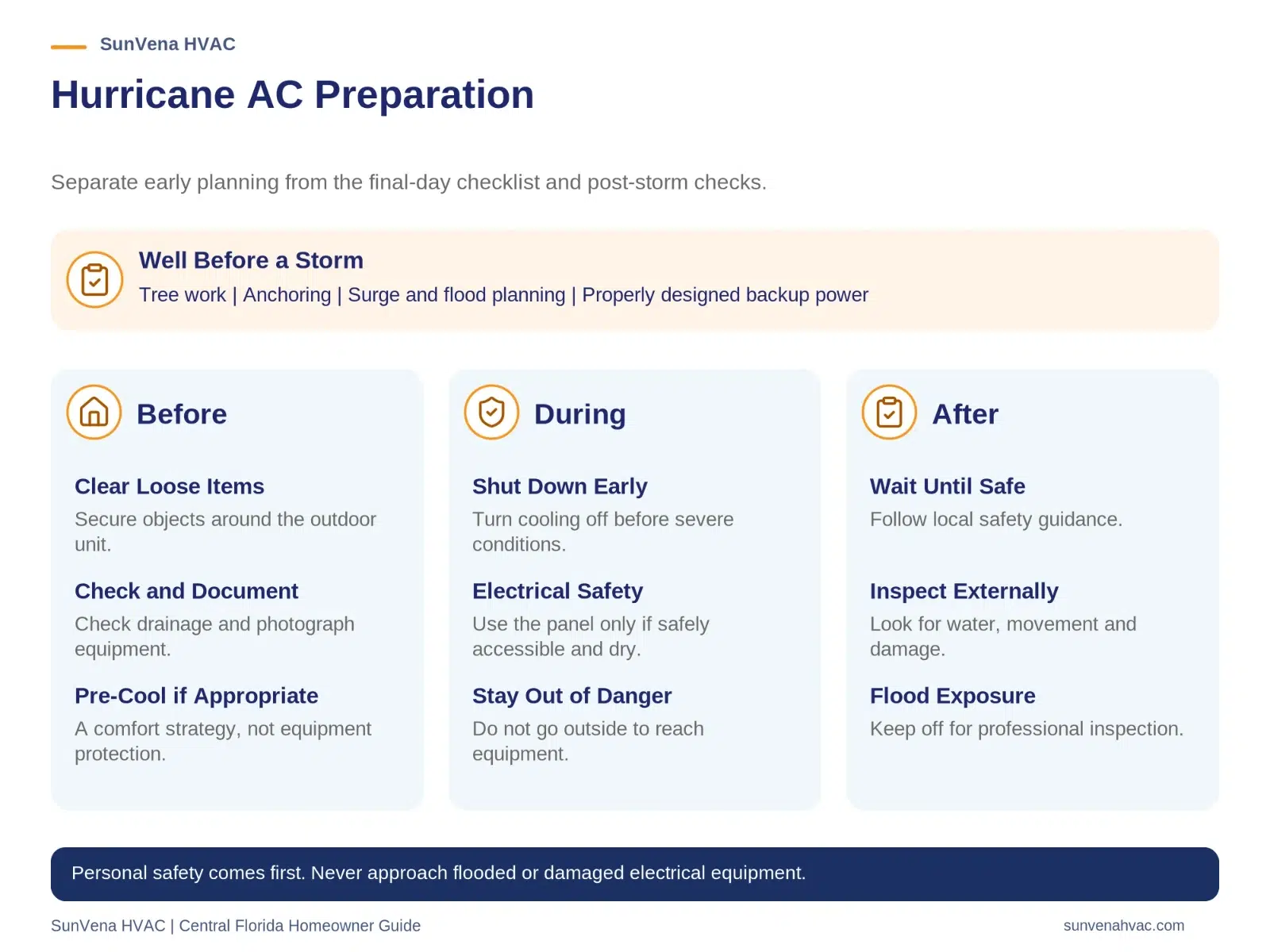
For homeowners across Greater Orlando, Seminole County, Orange County, and Volusia County, hurricane preparation should happen in stages. Tree work, condenser anchoring, surge protection, generator planning, and flood mitigation belong well before the forecast turns urgent. The final day is for simple tasks such as clearing loose objects, pre-cooling the house, photographing equipment, and knowing how you will safely shut the system down.
What Should You Do to Prepare Your AC Before a Hurricane?
The best hurricane HVAC checklist starts before a storm is on top of Central Florida.
Weeks or Months Before Hurricane Conditions
- Address overhanging limbs early. Trane recommends trimming branches that could fall onto the condenser as a seasonal preparation task, not waiting until dangerous weather is approaching.
- Check that the outdoor unit is securely installed. The condenser should be properly supported and anchored for the installation. Do not attempt last-minute structural modifications during deteriorating weather.
- Consider surge protection. A properly selected HVAC or whole-home surge protective device can reduce exposure to voltage surges, although no surge protector can guarantee that equipment will never be damaged.
- Plan for flooding if your property is vulnerable. Elevating or relocating HVAC equipment is a professional mitigation project that should be designed and completed before hurricane season, not during a warning.
- Plan backup power before you need it. If you want to run central AC from a generator, the generator and transfer equipment should be sized for the actual HVAC starting and running loads before an outage occurs.
- Schedule maintenance if the system is already due. A pre-season AC maintenance visit can identify drainage, electrical, airflow, or equipment problems before storm recovery puts unusually high demand on the system.
Trane’s storm-preparation guidance for residential HVAC systems recommends addressing tree limbs, surge protection, equipment security, generator planning, pre-cooling, storm shutdown, and post-storm inspection as separate parts of preparation.
The Day Before the Storm
- Clear loose items around the condenser. Bring in or secure patio furniture, potted plants, toys, tools, decorations, lightweight fencing components, and other objects that could become wind-driven debris.
- Check the area around the outdoor unit. Remove loose leaves and visible debris without opening the cabinet or disturbing electrical or refrigerant components.
- Confirm condensate drainage is functioning normally. Central Florida’s humid weather produces substantial condensate. If the drain is already backing up, have the problem corrected before the storm rather than prescribing one cleaning method for every installation. See our guide to an AC leaking water in Central Florida.
- Photograph the equipment. Take clear photos of the outdoor condenser, indoor equipment where safely accessible, model and serial number labels, and the surrounding installation. These can help document pre-storm condition if damage occurs.
- Know how to shut the system down. Identify the thermostat and clearly labeled HVAC breakers before severe weather begins. Do not wait until the area around the panel is wet or unsafe.
Should You Pre-Cool Your Central Florida Home Before a Hurricane?
Pre-cooling can be reasonable when a power outage is likely. Trane recommends cooling the home somewhat below the normal setting before a severe summer storm, then closing curtains and blinds and keeping doors and windows shut to retain conditioned air.
There is no need to turn the home into an icebox or choose one universal temperature. How much a home can comfortably pre-cool depends on the equipment, insulation, building envelope, occupants, indoor humidity, and normal thermostat setting.
Pre-cooling is a comfort strategy, not protection for the air conditioner itself. Once severe conditions are approaching, the focus shifts from storing cool air to keeping the HVAC equipment safely off.
Should You Cover the Outdoor AC Unit Before a Hurricane?
Do not wrap an outdoor condenser in an improvised plastic tarp and do not operate the system while anything blocks its airflow.
Outdoor condensers are designed to tolerate rain. During hurricanes, the more serious physical threats are wind-driven debris, falling limbs, flooding, and movement of poorly secured equipment.
Advice about temporary hurricane covers varies by equipment and protection method, so avoid treating any improvised cover as universally safe. A poorly secured tarp, board, or homemade shield can become a wind hazard itself. If you want physical debris protection, use only a manufacturer-approved or properly engineered solution that does not damage the equipment, and install it according to its instructions before severe weather arrives.
For most homeowners facing an approaching storm, removing loose objects around the unit is safer and more useful than improvising a last-minute enclosure.
Should You Turn Off Your AC During a Hurricane?
HVAC manufacturer guidance supports shutting the system down before the strongest storm conditions. Trane recommends turning the air conditioner or heat pump off at the thermostat and circuit breaker before evacuating or sheltering for a severe storm because power surges and storm debris can damage operating equipment.
The timing should prioritize personal safety. Do not go outside or approach electrical equipment after conditions become hazardous simply to shut down the HVAC system.
A practical sequence is:
- Pre-cool the home earlier if you choose to do so.
- Before severe conditions arrive, set the thermostat to Off.
- If you are comfortable identifying the correct HVAC breakers and the panel and surrounding area are completely dry and safe, follow the equipment or contractor guidance for shutting off HVAC power.
- Do not touch the electrical panel if water is present, flooding has begun, or there are signs of electrical damage.
Surge protection can provide another layer of protection from electrical transients, but it should be installed before storm season. It does not make running the AC through severe storm conditions risk-free.
What If Floodwater Reaches the Air Conditioner?
Do not turn flood-exposed HVAC equipment back on.
The Electrical Safety Foundation International says electrical equipment exposed to water should be inspected by qualified professionals before being returned to service. Water can cause hidden corrosion and electrical damage even after the outside of the equipment appears dry.
This applies when floodwater reaches the:
- Outdoor condenser or heat pump
- Air handler or furnace
- HVAC disconnect
- Electrical panel
- Wiring, controls, motors, or other electrical components
Never wade into floodwater to reach HVAC equipment or a breaker panel. Floodwater can conceal energized electrical hazards. ESFI specifically warns people not to touch submerged electrical equipment and to stay out of flooded areas until electrical hazards have been addressed.
What Should You Check Before Restarting the AC After a Hurricane?
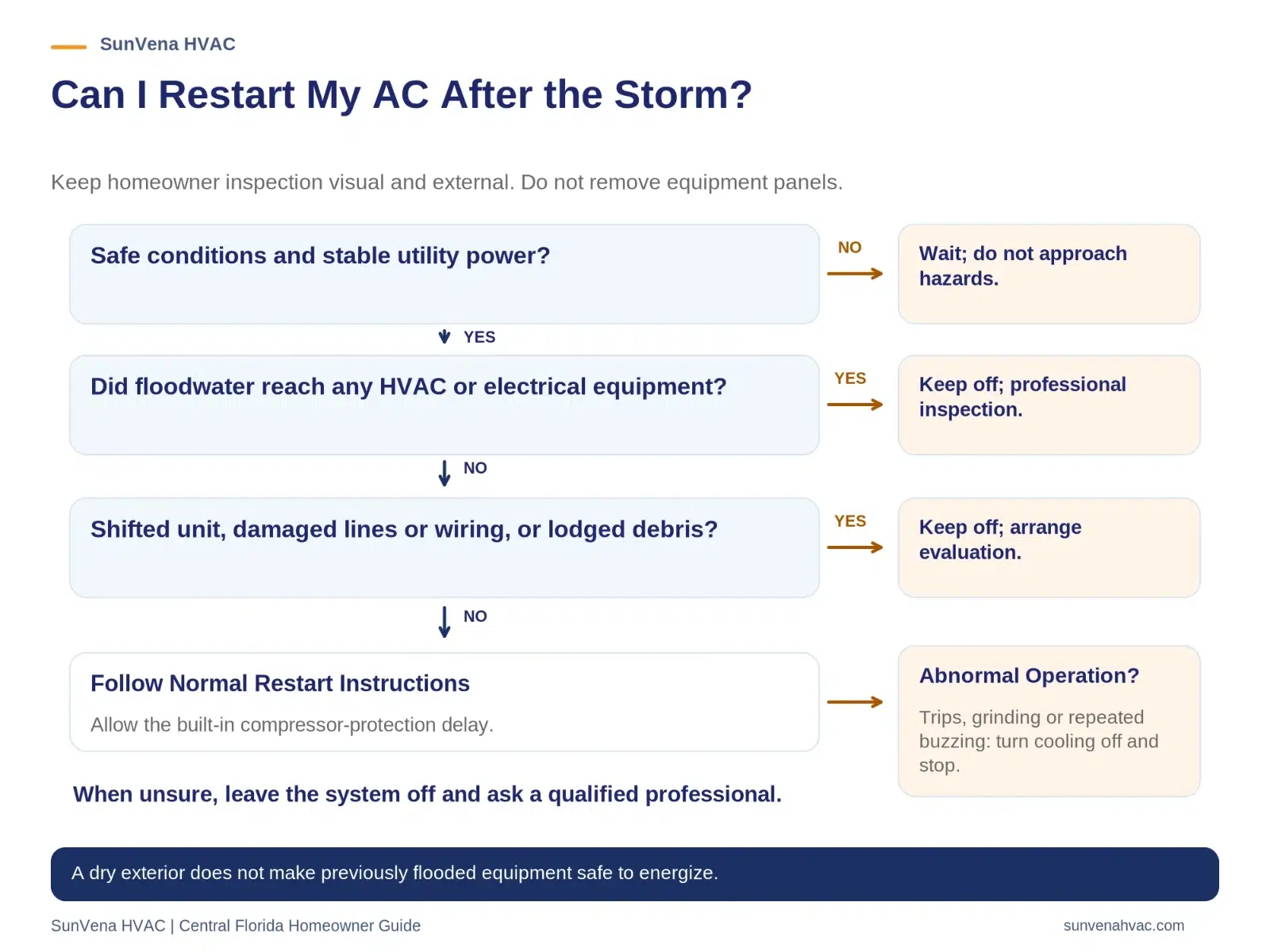
When local officials say conditions are safe and utility power has returned, inspect the system before calling for cooling.
| What You See or Hear | What to Do |
|---|---|
| Floodwater reached HVAC or electrical equipment | Leave power off and have the equipment professionally inspected before energizing it. |
| Condenser shifted, tilted, or moved on its pad | Do not run it. Movement can stress refrigerant lines, electrical connections, or the base. |
| Refrigerant lines are kinked, broken, pulled, or visibly damaged | Keep the system off and schedule HVAC service. Do not touch or attempt to repair refrigerant tubing. |
| Debris is lodged in the fan area or cabinet | Do not reach into the unit. Leave it off if debris cannot be safely removed from outside the cabinet without contacting equipment. |
| Missing panel, exposed wiring, scorching, burning odor, or damaged disconnect | Do not restore HVAC power. Arrange professional electrical or HVAC evaluation. |
| No obvious damage and equipment remained above floodwater | Once utility power is stable, restore the system according to normal operating procedures and allow any built-in compressor protection delay to expire. |
| Breaker trips, unit buzzes repeatedly, grinds, or fails to start normally | Turn cooling off and stop. Do not repeatedly reset a tripping breaker. |
Do not remove condenser access panels for the inspection. Homeowner checks should remain visual and external. If the system trips a breaker after the storm, use our guide to an air conditioner that keeps tripping the breaker rather than repeatedly attempting to restart it.
How Should You Handle Indoor Humidity After a Long Power Outage?
Once the HVAC system is confirmed safe to operate, restoring cooling also restores dehumidification. Central Florida homes can accumulate substantial moisture during extended warm-weather outages, especially when wet building materials or storm-related water intrusion are also present.
The EPA’s mold and moisture guidance emphasizes moisture control and recommends drying water-damaged materials within 24 to 48 hours when possible. EPA also recommends keeping indoor relative humidity below 60 percent, with roughly 30 to 50 percent preferred when practical.
After power is safely restored:
- Run the air conditioner normally in Cool mode.
- Use the thermostat fan setting on Auto unless your equipment or HVAC professional recommends otherwise. Continuous fan operation can re-evaporate moisture from a wet cooling coil on some systems.
- Address roof, window, plumbing, or floodwater intrusion separately. The AC cannot correct saturated building materials by itself.
- Use dehumidification equipment when appropriate and when safe electrical power is available.
- Do not run HVAC equipment that was itself exposed to floodwater just to dry the home.
If indoor humidity remains high after cooling is restored, SunVena’s Central Florida indoor air quality and humidity services can help identify whether the issue is storm moisture, equipment performance, airflow, duct leakage, or a separate moisture problem.
Can a Portable Generator Run Central Air Conditioning?
Some portable generators can run some central air conditioners, but the answer has to be calculated for the specific generator and HVAC system. It is not safe to assume that a generator is large enough simply because its advertised running wattage appears to exceed the AC’s normal operating load.
Air conditioners and heat pumps use electric motors and compressors that can require substantially more power at startup than during steady operation. Generac notes that motorized loads such as air conditioners can require starting wattage several times their running wattage. Generator sizing should consider the HVAC equipment’s actual voltage, running load, locked-rotor or starting requirements, and any other loads operating at the same time.
A soft-start device can reduce compressor starting current on compatible equipment, but it does not automatically make every generator suitable for central AC. The generator still needs sufficient capacity and the electrical installation still needs to be designed correctly.
For a hardwired connection to a home’s electrical system, FEMA advises using a qualified electrician and appropriate transfer equipment rather than backfeeding the home through an improvised connection. See FEMA’s generator safety guidance.
Generator Safety Matters More Than Cooling
The National Weather Service warns that carbon monoxide poisoning is a major post-hurricane danger. Portable generators should be operated outdoors, at least 20 feet away from the home, doors, windows, and other openings, following the manufacturer’s instructions. A working carbon monoxide alarm should be inside the home.
Never run a generator in a garage, carport enclosure, home, crawlspace, or other enclosed or partially enclosed area, even with doors open.
Should You Photograph Your HVAC System Before and After a Hurricane?
Yes. Photos and video can help document the equipment’s condition and the cause and extent of storm damage.
Before the storm, document:
- The condenser from several angles
- The equipment model and serial number labels
- The pad or mounting location
- The refrigerant lines and electrical disconnect from a safe distance
- The indoor air handler or furnace where safely accessible
After the storm, photograph damage before moving or repairing equipment when it is safe to do so. Do not enter floodwater or approach electrical hazards for the sake of taking pictures.
Insurance coverage depends on the policy and the cause of loss. FEMA notes that wind and flood damage from the same hurricane can involve separate claims, and standard homeowners insurance generally does not cover flooding. Contact your insurance company or agent for coverage decisions rather than relying on the HVAC contractor to interpret the policy.
What Central Florida Hurricane AC Preparation Should Happen Before Storm Season?
The most valuable HVAC storm preparation is the work that cannot safely be completed during a hurricane warning:
- Tree trimming
- Equipment anchoring or elevation
- Surge protection
- Generator sizing and transfer equipment
- Correction of chronic condensate drainage problems
- Repair of loose electrical equipment or deteriorated disconnects
- Routine AC maintenance
- Documenting model, serial, warranty, and insurance information
When a storm is already approaching, focus on personal safety, securing loose items, documenting equipment, pre-cooling if desired, and shutting the system down before hazardous conditions arrive.
Frequently Asked Questions
Can I run my AC while a hurricane is passing through Central Florida?
HVAC manufacturer guidance recommends shutting the system down before severe storm conditions rather than operating it through the worst weather. Pre-cool earlier if desired, then turn cooling off before conditions become dangerous. Personal safety and official emergency instructions always take priority over HVAC equipment.
Will heavy hurricane rain damage my outdoor AC unit?
Ordinary rain, including heavy rain, is not the same as flooding. Outdoor condensers are built for outdoor weather exposure. The larger concerns are rising floodwater, wind-driven debris, falling limbs, equipment movement, electrical damage, and physical damage to refrigerant lines or the cabinet.
Should I turn the AC breaker off before a hurricane?
Trane recommends shutting off the air conditioner at the thermostat and circuit breaker before severe storm conditions. Only operate the breaker if you can safely identify it and the panel and surrounding area are dry and undamaged. Never approach a wet or flood-exposed electrical panel.
Can I restart my AC as soon as utility power returns?
Inspect the outdoor and indoor equipment first. If there was flooding, equipment movement, physical damage, exposed wiring, damaged refrigerant lines, or other hazards, leave it off. If the equipment appears undamaged and remained dry, wait until utility power is stable, restore normal power, and allow any built-in compressor protection delay to expire.
What if floodwater only touched the bottom of the condenser?
Do not guess how far water reached internal electrical or mechanical components. ESFI recommends professional inspection of electrical equipment exposed to water before it is returned to service. Leave the condenser off until it has been evaluated.
Can a soft-start device let my portable generator run the AC?
It may reduce compressor starting current on compatible equipment, but generator compatibility still depends on the AC’s actual electrical requirements, generator capacity, other loads, wiring, transfer equipment, and manufacturer requirements. Have the system evaluated before relying on it for hurricane backup power.
Does homeowners insurance cover hurricane damage to an AC?
It depends on your policy and what caused the damage. Wind, falling debris, lightning, power-related damage, and flooding can be treated differently. FEMA notes that homeowners policies generally do not cover flood damage and that wind and flood losses from the same storm can require separate claims. Ask your insurer or agent about your specific coverage.
Post-Storm AC Service in Central Florida
If your HVAC system was flooded, struck by debris, shifted on its pad, damaged by a power event, or will not restart normally after a hurricane, SunVena HVAC provides AC diagnostics and emergency service throughout Central Florida.
Homeowners can find local HVAC service information for Orlando and Sanford, or view SunVena’s complete Central Florida HVAC service area across Greater Orlando and Volusia County.
For urgent storm-related cooling problems, use SunVena’s 24/7 emergency HVAC service. For non-emergency inspections or maintenance, schedule HVAC service online or call (321) 621-5156.
Safety note: Never enter floodwater to reach HVAC or electrical equipment, touch water-exposed electrical components, open energized HVAC panels, manipulate damaged disconnects, handle refrigerant lines, or connect a portable generator directly to home wiring without approved transfer equipment.